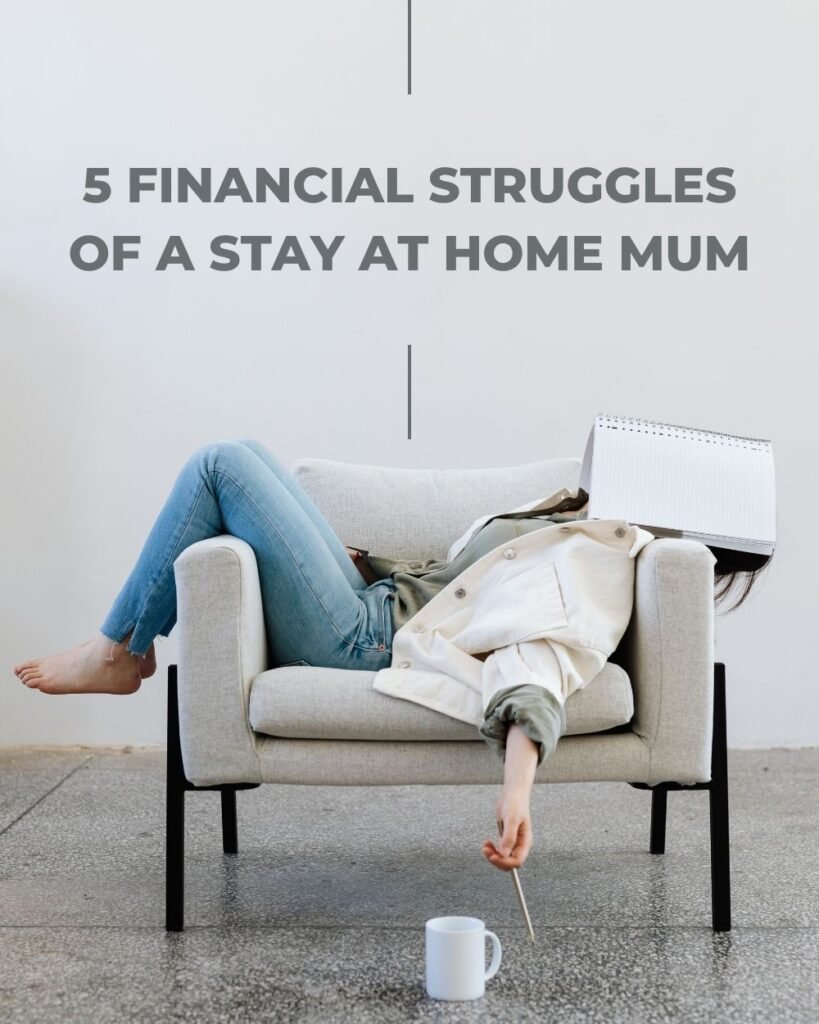
Discover the 5 financial struggles many stay-at-home-mums face and learn practical steps to build financial independence, emergency savings, and long-term security.
Being a stay-at-home mum is unpaid labour. It is work that requires discipline, planning, emotional strength, and constant sacrifice. You are raising future adults, managing a household, supporting your partner’s career, and holding the emotional structure of the family together.
Yet financially, many stay-at-home mums are left vulnerable.
No income in their own name. No personal pension. No emergency fund. No financial autonomy.
Over time, that vulnerability can quietly chip away at confidence and identity.
I have been a stay-at-home mum for the past 14 years, and I still am. So I am not writing this from theory. I am writing from lived experience. I understand what financial dependence feels like. I understand how it can affect your decision-making, your confidence, and even your sense of self.
These struggles are not a reflection of incompetence. They are structural and emotional realities that deserve to be addressed honestly.
In this post, I want to speak openly about five financial struggles of a stay-at-home mum — and more importantly, outline practical steps to build financial security, independence, and long-term stability.
1. Financial Dependence That Erodes Confidence
One of the most difficult parts of being a stay-at-home mum without personal income is the constant need to ask. Asking for household money. Asking for personal expenses. Asking for approval before making decisions. Over time, this dynamic can create a subtle shift in power. Even in stable marriages, financial dependence can make you feel smaller than you are.
When every expense depends on someone else’s approval, it affects your confidence. It affects how you speak. It affects the risks you are willing to take.
Action Plan:
- Open a bank account in your own name, even if you have nothing to deposit yet. The act itself creates a mental shift.
- Start tracking household expenses so you understand exactly where money is going.
- Begin saving something small — even £5 a week — into a separate emergency pot.
- If possible, look for part-time or flexible work during school hours to build your own income stream.
Financial independence does not begin with a large salary. It begins with ownership and awareness.

2. No Pension and No Retirement Security
Many stay-at-home mums in the UK do not have a private pension in their own name. This creates a very real fear: what happens at 65 or 70? What if circumstances change? What if you outlive your partner? What if you do not want to depend on your children financially?
The thought of poverty in old age or becoming a burden can quietly create anxiety and regret.
Action Plan:
- Educate yourself about investing, especially low-cost index funds.
- Open a Self-Invested Personal Pension (SIPP).
- Even if you are not employed, you can contribute up to £2,880 per year (£240 per month), and the government will add £720 in tax relief, making it £3,600 annually.
- Invest in low-cost, broad market index funds and contribute consistently.
Your pension can quietly grow in the background while you focus on raising your children.
3. Loss of Financial Identity and Self-Worth
There is something subtle that happens when you do not earn money for years. Slowly, you begin to question your capability. You may start feeling invisible in a world where financial independence is associated with power and respect.
Running a home requires budgeting, time management, negotiation, and emotional intelligence. But because it is unpaid, it can feel undervalued.
Rebuilding your financial identity is not about competing with anyone. It is about restoring your own belief that you can take care of yourself if you ever needed to.
Action Plan:
- Choose one income-producing skill and commit to developing it.
Bookkeeping, digital marketing, tutoring, freelancing, virtual assistance, remote admin work — focus on one. - Aim to earn your first £100 independently.
That first income is proof of capability. - Use your own bank account for any earnings.
Let money flow through your name. That builds confidence and ownership.
Financial identity grows through action, not theory.
4. Mental Exhaustion and Lack of Financial Awareness
Many stay-at-home mothers are mentally exhausted. The repetition of housework, meal planning, school runs, and emotional labour drains cognitive energy. By the end of the day, there is little space left for long-term financial planning.
This is not laziness. It is overload.
Instead of waiting for perfect conditions, create small structured habits.
Action Plan:
- Protect 20 minutes to one hour a day for “Future You.” Use it to learn about investing, update your CV, research opportunities, or build a skill.
- Listen to personal finance audiobooks or investing podcasts while doing chores.
- Simplify wherever possible — rotate meals, automate savings and investing, use one budgeting system.
Twenty minutes a day becomes 10 hours a month. That compounds into knowledge and confidence.

5. No Emergency Fund and Lack of Financial Autonomy
An emergency fund is not pessimistic. It is protective. Life can change suddenly — illness, job loss, separation, or death of a spouse. Without personal savings, a stay-at-home mum can become extremely vulnerable.
An emergency fund represents options.
Action Plan:
- Open a separate savings account in your own name.
- Start small and contribute consistently, even £5–£10 per week.
- Aim for three to six months of essential living expenses (housing, utilities, food, transport).
- Keep it separate and protected.
Financial privacy is not disloyalty. It is autonomy.

Financial Self-Care Is Real Self-Care
Self-care is often spoken about as relaxation or pampering. But real self-care is doing what protects your future. Taking control of your finances is one of the most powerful forms of self-care a stay-at-home mum can practise.
When you build savings, contribute to a pension, or develop a skill, your confidence increases. Your energy shifts. You feel steadier.
No one is going to build your financial security for you. You must take action. Reading about money is not enough. Consuming financial content without implementing it will not change your life.
Instead of endless scrolling, apply what you learn. Open the account. Build the fund. Learn the skill. Contribute to the pension.
You do not need dramatic change. You need consistent action.
I have been a stay-at-home mum for 14 years, and I still am. But I no longer see that as a limitation. I see it as a phase of life that requires strategy.
You yourself deserve love and respect as much as anyone else. Building financial independence in your own name is one of the most practical ways to give that respect to yourself.
Start small. Start quietly. But start.
At Mindful Money & Self Development, we focus on helping women in their 40s build financial independence, long-term security, and self-respect through practical investing and intentional living.
If this post helped you, share it with another woman who needs to start securing her financial future.
About Mindful Money & Self Development
Mindful Money & Self Development is dedicated to helping women-especially those in their 40s without workplace pensions-take practical steps toward financial independence. Through investing education, retirement planning guidance, and personal growth strategies, this platform empowers women to secure their future with clarity and confidence.